
Article Summary
- BETFIN V2 doesn't just introduce a new product — it introduces a framework for community-driven game development.
- Developers can build new games, but the core economy and liquidity remain protected within the base protocol.
- The fundamental system logic — bet intake, settlement, payouts, limits, and liquidity flow — runs within a single audited contract.
- New games must pass approval from decentralized governance before going live.
From Product to Open Framework
One of the most significant shifts that BETFIN V2 introduces is the transition from a single product to an open gaming framework.
In most online gambling platforms, new games are built internally by a single company. The development team prepares a product, goes through a lengthy audit process, and brings it to market after months of work.
BETFIN V2 flips this model entirely.
Instead, an open infrastructure emerges where the entire community can build games. Developers gain the freedom to innovate and experiment with game mechanics.
At the same time, one fundamental rule applies:
The community can create games, but cannot interfere with the system's economy.
In other words — developers have the freedom to build, but they cannot threaten the protocol's liquidity, reserves, or security.
Clearly Defined System Boundaries
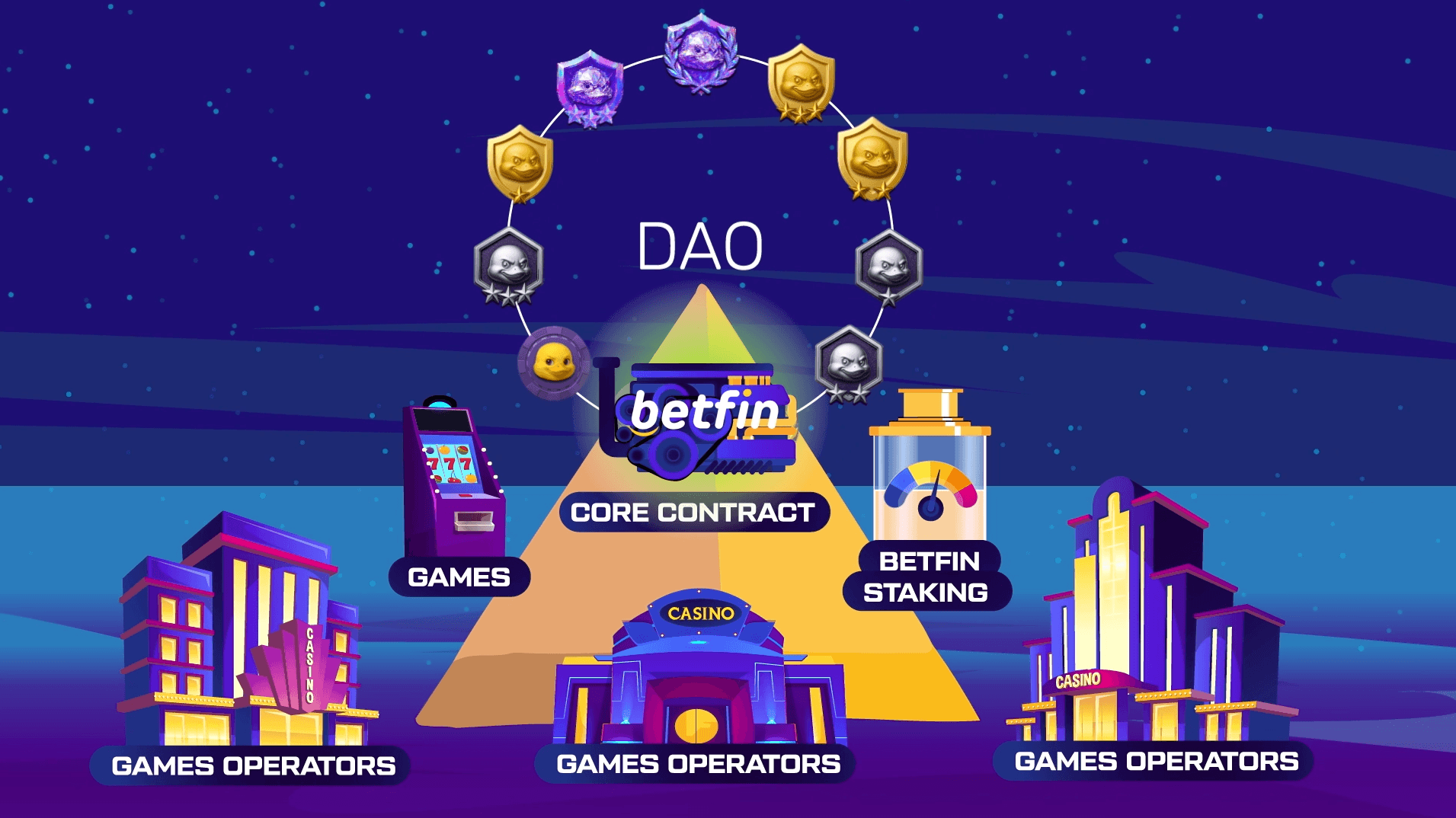
To keep this model secure, BETFIN V2 introduces a strict separation between two distinct layers.
1. Core Protocol — The Untouchable Layer
This is where everything related to the system's economy runs:
- Bet intake
- Result settlement
- Payouts
- Limits
This logic lives within a single audited smart contract that forms the backbone of the entire ecosystem.
2. Game Layer — The Space for Innovation
This is where developers can build:
- Game mechanics and rules
- User interface and visual design
- Multiplayer interactions
A developer builds the game logic, but the movement of funds remains governed entirely by the protocol.
The outcome is significant: the system can innovate rapidly, while its economy remains secure and auditable.
How Games Are Technically Connected
Game development in BETFIN V2 is decentralized — in theory, anyone in the community can build a new game.
To prevent chaos, however, every game must use one of four standardized contract types:
- Conservative Game
- Dynamic Single-Player
- Dynamic Multiplayer
These contract types form the core architectural framework. Developers don't need to worry about settlement infrastructure, liquidity, or payout mechanisms. They simply focus on building the game itself.
The principle is similar to mobile app development. A developer doesn't build their own operating system — they build on top of existing infrastructure.
Decentralized Governance as a Security Filter
Governance is a critical component of the system.
A new game does not automatically go live in production. It must first pass approval from decentralized governance, which has several security tools at its disposal:
- It can require an external audit
- It can set a maximum win per settlement epoch — essentially a risk cap
Even experimental games can be launched relatively quickly, but only within strictly defined limits.
Security Through Risk Management
This model introduces a compelling security principle.
Rather than requiring every new game to wait months for a full audit, it can be launched with a limited exposure.
For example: governance approves a new game with a maximum exposure of $10,000 per settlement epoch. If a bug or exploit were to appear in the code, the maximum possible loss is capped at exactly that amount.
In practice, this creates an environment similar to a bug bounty program:
- If someone discovers and exploits a vulnerability, they can only draw on a limited pool of funds
- That pool effectively acts as the bounty amount
The protocol remains protected, and the community can innovate at a much faster pace.
Settlement Always Flows Through the Core Framework
Even though games are created by the community, funds do not flow through the game contracts themselves.
All settlement and movement of funds always passes through the core framework, which enforces:
- Rule validation
- Limits
- Payout logic
Innovation happens at the level of game design, while the economic integrity of the system remains protected at the protocol level.
Audited Core and Decentralized Governance
The core framework contracts are audited and shared across all games.
This does not mean, however, that every new game is automatically safe. A developer can still create a game with a bug — or even with deliberately malicious logic.
That is why BETFIN combines:
- Audited infrastructure
- Decentralized governance
- Risk caps
Every game must pass a framework compatibility review, which covers areas such as:
- Input data validation
- Interface compatibility
- Fairness of game logic
- Testing
This makes it possible to dramatically accelerate the onboarding of new games without making any compromises on security.
Why This Is a Fundamental Shift
This model delivers three key advantages:
Speed — New games can be developed and launched within days or weeks, not months.
Security — Liquidity, payouts, and the broader economy remain protected by the audited core contract.
Scalability — More developers means more games. More games means more players. More players means higher betting volume. And higher volume means greater revenue for BETFIN's liquidity economy.
Conclusion
BETFIN V2 doesn't just represent a technological upgrade. It represents a new model for game creation.
Instead of centralized development, an open ecosystem emerges — one where the community can innovate and craft new gaming experiences, while the system's economy, liquidity, and security remain protected within the audited core protocol.
The result is a model that combines the best of both worlds: the freedom to innovate at the game layer, and the stability of infrastructure at the protocol level.
And it is precisely this combination that enables BETFIN to gradually transform from a single platform into an entire community-powered gaming ecosystem.

.png&w=3840&q=75)