Article Summary
- BETFIN V2 is designed as regulatory-compatible infrastructure, not another crypto casino.
- The platform operates as a decentralized SaaS that regulated operators can also utilize.
- Critical parts of the system (funds, settlement, governance, rules) run on-chain and are auditable.
- The operator remains the regulated counterparty to the player and controls their own execution layer.
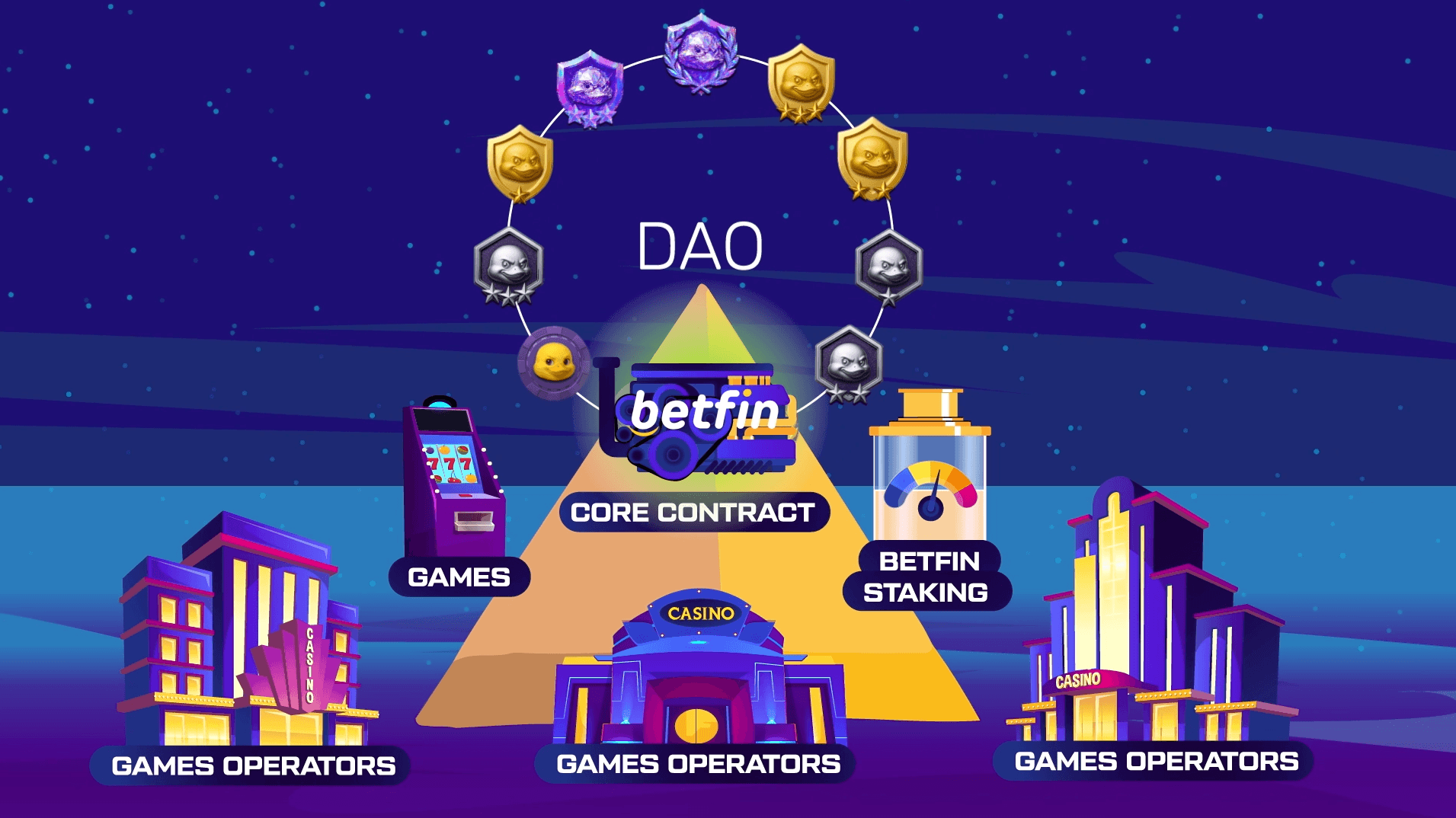
- The Core protocol is neither a service provider nor a counterparty — it functions as an infrastructure framework for settlement relationships.
- The architecture reduces the partner's regulatory risk while accelerating onboarding of new operators.
- BETFIN V2 delivers fully productized infrastructure that enables scaling of partner and game onboarding without technical bottlenecks.
Partners gain technology, liquidity, and a distribution network in a single ecosystem.
On-Chain Infrastructure Ready for the Regulated World
From day one, BETFIN has pursued a single strategic goal: to build on-chain infrastructure compatible with the reality of regulated markets. This is not a compromise on decentralization — quite the opposite. It is a way to enable Web3 technologies to function in the real economy.
A regulated operator does not need "another crypto casino." They need infrastructure that meets specific requirements: it must be auditable, transparent, allow risk management configuration, and be compatible with compliance demands. At the same time, it must deliver the performance and liquidity that traditional systems often cannot provide.
This is exactly where BETFIN V2 comes in.
Not a pivot. A mature strategy.
One thing must be emphasized: the approach toward regulated partners is not a change of direction. It is the fulfillment of the original vision.
BETFIN V1 demonstrated that fully on-chain infrastructure can work. The problem was not the technology, but adoption. Partner integration was too manual, onboarding too complex, and the system was not prepared for rapid scaling. BETFIN V2 solves this — it brings productized infrastructure that allows the community to onboard partners and games significantly faster.
What "decentralized SaaS" means
The simplest way to think about BETFIN V2: a SaaS platform with no central owner. Like a classic SaaS solution, it provides partners with a complete technology stack — onboarding tools, parameter configuration, monitoring, reporting, risk management, settlement infrastructure, and integration standards.
From the partner's perspective, this is a familiar model. The difference is that the critical parts of the system do not run on one company's servers, but on the blockchain.
Decentralized core
Key components — asset management, transaction settlement, governance, and the core protocol rules — are on-chain. The infrastructure is therefore transparent, auditable, and free of any single point of failure. Protocol rules are also immutable, and its operation is permissionless.
The operator remains the regulated counterparty
One of the most important properties of the architecture is the role of the operator. The operator has their own relationship with the user, performs KYC/AML, is responsible for compliance, and pays out players. BETFIN Core is not a counterparty between the player and the operator.
The operator also controls their own execution layer: they own their mirroring contract, control their own operations, and are not operationally dependent on Betfin or on the Core protocol. The result is significantly reduced regulatory risk.
Faster Partner Onboarding
This architecture offers a key advantage: a regulated partner does not need to build technology from scratch. Instead, they connect to infrastructure that already includes:
- a liquidity layer
- a settlement framework
- risk management
- integration standards
Why a partner should join
BETFIN V2 offers operators several concrete benefits.
Lower capital requirements
Partners do not need to hold as deep reserves of their own bankroll, because they can draw on the infrastructure's shared liquidity.
Cashback on partner volume
A portion of the value generated by volume is returned to the ecosystem through defined reward mechanisms.
Access to new games
Through the community framework, partners can quickly gain access to new games created within the ecosystem.
Network effect
Affiliate distribution and the community bring players across the ecosystem. For the partner, this means access to a distribution network that already exists.
V1 vs V2: Why the Change Matters
The difference between BETFIN V1 and V2 lies primarily in productization.
V1
- strong technological vision
- functional infrastructure foundation
- but partner onboarding was too manual
V2
- standardized modules
- integration layer
- governance model
- scalable onboarding of partners and games
As a result, each new integration no longer represents a technical bottleneck. The community can add new partners and new games much faster.
Conclusion
BETFIN V2 is not merely a technology upgrade. It is a shift toward a model that can be described as decentralized SaaS for the gaming industry. Partners gain enterprise-grade technology, access to liquidity, network distribution, and regulatory-compatible architecture — all without a central owner and without a single point of failure.
The result is infrastructure capable of bridging two worlds: decentralized Web3 technology and the reality of the regulated gaming industry.